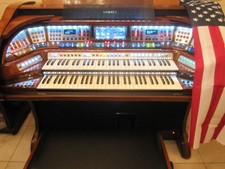
Lowrey Organ Serial Numbers
Things Needed • Pencil • Paper • Computer • Phone Lowrey organs are sometimes inherited or passed on to family members for various reasons. The history of the organ can be lost through time, as well as the age of the organ. Organs obtained through other sources may not have a manual available. The year of the organ will be needed if parts or services are necessary. Locate the model plate on the back of the organ or under the keyboard.
Copy the model number and the model of the organ. This information will provide the exact year of the organ. Compare the information with the online site located at OrganService.com. Search through the numbers located on the left side of the screen. Once the model number has been found, confirm the organ model is correct.
Copy the model number and the model of the organ. This information will provide the exact year of the organ. Compare the information with the online site located at OrganService.com. Search through the numbers located on the left side of the screen.
The last column will provide the year of the organ. Dial 1-800-451-5940 for models not included on the website list.
Guitar hero dlc list. Lowrey Genie 44 electronic organ (1970s) The Lowrey organ is an named for its developer, Frederick Lowrey, a -based and entrepreneur. Campbell pd dan livingston. It is currently produced. During the 1960s and 1970s, Lowrey was the largest manufacturer of electronic organs in the world. In 1989, the Lowrey Organ Company produced its 1,000,000th organ. Up until 2011, modern Lowrey organs were built in LaGrange Park, Illinois.

In 2011, it was announced that production of a few models was to be moved to Indonesia. Most notably, the Lowrey organ differs from the (which also bears the name of its Chicago-based inventor) in its incorporation of 'automatic accompaniment' features.
While originally intended for the, it was also used by some in the 1960s and 1970s., the keyboardist of, played a Lowrey Festival organ on many of the group's most notable songs. Its sound can be heard prominently on the 1968 recording of ', which begins with a -inspired prelude/intro. The Lowrey Organ is one of several organs on ' 1967 song ' (from the album), helping create a fairground atmosphere. Furthermore, a Lowrey DSO Heritage organ was used to produce the classic opening for '. The Lowrey Organ and its build-in drum patterns are also heard on the million-seller single, 'Why Can't We Live Together' of Timmy Thomas. A rather surprising use of a Lowrey Organ, on a percussive 'marimba repeat' setting, was the -like background noise on song '.
Of switched from a to a Lowrey Holiday Deluxe sometime between late 1966 and early 1967, and used it from then on, adding a and plugging it into a stack. To prevent in the silences between notes (consequence of playing at a very high volume), Ratledge invented a style of his own avoiding the between-note gaps by soloing in. [ ] made use of the instrument quite extensively on his album, and on several later albums as well. The song State of the Art was written to showcase the sounds of the Lowrey Cotillion model D-575.
From 1966 to 1971, Lowrey also produced for while the guitar manufacturer was owned by parent company. The most popular of these was first introduced in 1966 as the, but was renamed the shortly thereafter. The Gibson branded organs' design and circuitry were similarly based on Lowrey's own 'T-1' and 'T-2' models, as well as their 'TLO-R' and 'Holiday' spinet models. However, they had several additional features that made their sound distinctive from other Lowrey models, including 'Repeat', 'Glide', and 'Trumpet Wow-wow' effects. References [ ]. ' In 1956, the Glide, a foot switch located on the left side of the expression pedal, was introduced, permitting the effects of a Hawaiian guitar “glide”, the smear of a trombone, the glissando of singing strings and the effect of a calliope.
The Glide dropped the pitch of the organ about a semi-tone and cancelled the vibrato. / In 1961, Lowrey’s first home organ with a built-in Leslie speaker appeared as the Holiday Deluxe Model LSL. Automatic Orchestra Control, later renamed Automatic Organ Computer, came on the scene in 1963.