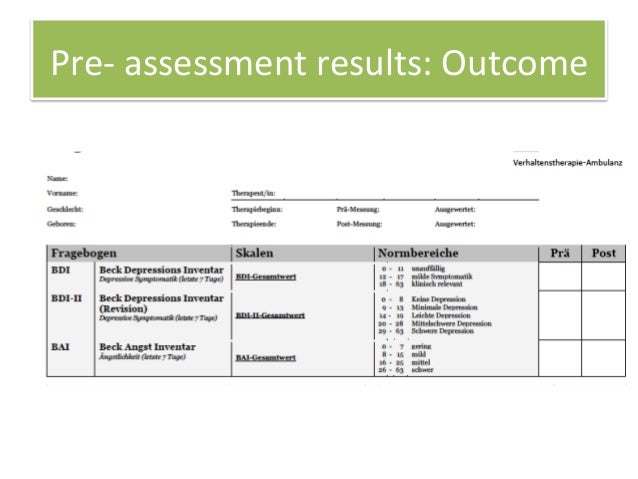
Beck-depressions-inventar Fragebogen
• • • The Beck Depression Inventory ( BDI, BDI-1A, BDI-II), created by, is a 21-question, one of the most widely used for measuring the severity of. Its development marked a shift among professionals, who had until then, viewed depression from a perspective, instead of it being rooted in the patient's own thoughts. In its current version, the BDI-II is designed for individuals aged 13 and over, and is composed of items relating to symptoms of depression such as hopelessness and irritability, cognitions such as guilt or feelings of being punished, as well as physical symptoms such as fatigue,, and lack of interest in sex. There are three versions of the BDI—the original BDI, first published in 1961 and later revised in 1978 as the BDI-1A, and the BDI-II, published in 1996. The BDI is widely used as an assessment tool by health care professionals and researchers in a variety of settings. The BDI was used as a model for the development of the (CDI), first published in 1979 by clinical psychologist.
Beck-Test / Beck-Depressions-Inventar (BDI) Der Beck-Test bzw. Das Beck-Depressions-Inventar in ein standardisierter Fragebogen zur Selbstbeurteilung des Patienten und dient der Feststellung des Schweregrades einer Depression. Beck Depressions-Inventar: BDI II. [Martin Hautzinger. Description: Manual 35 Seiten und Fragebogen 1 Seiten. Other Titles: Beck depression.
Dataset serialize outofmemoryexception. Contents • • • • • • • • • • Development and history [ ] Historically, depression was described in terms as 'inverted hostility against the self'. By contrast, the BDI was developed in a novel way for its time; by collating patients' verbatim descriptions of their symptoms and then using these to structure a scale which could reflect the intensity or severity of a given symptom. Beck drew attention to the importance of 'negative cognitions' described as sustained, inaccurate, and often intrusive negative thoughts about the self. In his view, it was the case that these cognitions caused depression, rather than being generated by depression. Beck developed a triad of negative cognitions about the world, the future, and the self, which play a major role in depression. An example of the triad in action taken from Brown (1995) is the case of a student obtaining poor exam results: • The student has negative thoughts about the world, so he may come to believe he does not enjoy the class.
• The student has negative thoughts about his future because he thinks he may not pass the class. • The student has negative thoughts about his self, as he may feel he does not deserve to be in college.
The development of the BDI reflects that in its structure, with items such as 'I have lost all of my interest in other people' to reflect the world, 'I feel discouraged about the future' to reflect the future, and 'I blame myself for everything bad that happens' to reflect the self. The view of depression as sustained by intrusive negative cognitions has had particular application in (CBT), which aims to challenge and neutralize them through techniques such as. BDI [ ] The original BDI, first published in 1961, consisted of twenty-one questions about how the subject has been feeling in the last week. Each question had a set of at least four possible responses, ranging in intensity. For example: • (0) I do not feel sad. • (1) I feel sad.